
You offer some of the most advanced lens technology in ophthalmology. Your surgical outcomes are excellent. And yet, when patients sit down across from you, they hesitate. They say they need to think about it. Or they go with the standard lens because it is covered.
This is one of the most common frustrations we hear from cataract surgeons: patients who could benefit from a premium IOL simply don’t choose one. And too often, the instinct is to assume patients just aren’t willing to pay out of pocket.
The data tells a different story. The gap between what patients could choose and what they do choose is largely an education problem. And it is one that starts long before the patient walks through your door.
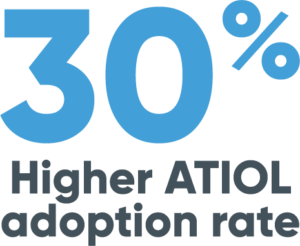
Practices using Navigate’s human-led pre-visit education see a 30.5% higher ATIOL adoption rate compared to patients educated by the practice alone.
The Real Reason Patients Default to Standard Lenses
When a patient arrives at their cataract consultation unprepared, they are not in a position to make an informed decision. They may not know the difference between a monofocal and a multifocal lens. They may have heard a number thrown at them for the first time in the waiting room. They are anxious about surgery. And they are expected to choose.
That pressure leads to one predictable outcome: patients choose the path of least resistance. The standard lens is covered, they understand it, and it feels like the safe bet.
It is not a values problem. It is a timing problem. And it is not your fault for not explaining it well in the exam lane. It is structurally impossible to give a patient everything they need to feel confident in a 10-minute consultation, especially when most of that time is already committed to clinical assessment. Giving patients more time to digest the idea of a premium IOL that caters to their lifestyle increases the potential of that conversion. Even if that IOL comes with out-of-pocket costs.
What the Research Says About Patient Decision-Making
Research on how patients make healthcare decisions consistently shows that people need time to process information before they can act on it. A study on informed consent and patient decision-making found that patients who received education before their appointment were significantly more prepared to engage in shared decision-making compared to those who received information only at the point of care.
For cataract patients, this matters enormously. The decision about which lens to choose is not purely clinical. It is tied to lifestyle, expectations about vision, and a patient’s understanding of what they are actually buying. When that education happens in a rushed consultation room, under bright lights, moments before a biometry reading, it does not land.
When it happens a few days before, at home, over a relaxed phone call with a trained educator? That is a completely different conversation.
The Education Gap in Cataract Surgery
Only around 15-18% of cataract patients in the United States currently choose a premium IOL, according to industry estimates. This is despite the fact that premium lenses have never been better, and despite decades of investment in patient education materials, portal videos, and digital tools.
Digital education has its place. But it does not replace a human conversation. A video cannot answer a follow-up question. A pamphlet cannot sense that a patient is anxious about cost and pivot to address it directly. A patient portal cannot recognize that a husband and wife have different priorities about the outcome and help them work through it together. This is where human-led pre-visit education changes the outcome.
What Navigate Does Differently
Navigate Patient Solutions places trained Patient Navigators between diagnosis and consultation. After a patient books their cataract evaluation but before they arrive, a Navigator connects with them by phone, video, or text to:
- Explain what cataract surgery is and what to expect on the day
- Walk through the lens options the practice offers, in plain language
- Help the patient understand what any out-of-pocket costs actually mean for their vision and lifestyle
- Answer the questions that patients are too anxious or rushed to ask their surgeon
- Share what they learn with the surgical team so the consultation starts from a position of trust
The Navigator doesn’t sell. They educate. And that distinction matters to both the patient and the surgeon.
In 2025, 74% of patients educated by Navigate went on to book their surgery, representing an 11% improvement over patients educated by the practice alone. And 35% chose a premium IOL!
The Exam Lane Conversation Changes
When patients arrive already educated, surgeons report that consultations shift entirely. Instead of spending the first several minutes explaining what a cataract is, surgeons can focus on what they do best: assessing the patient clinically and helping them choose the right lens for their life.
One Navigate partner practice reduced the average length of their cataract evaluations by 14 minutes. Another was able to add four additional evaluation appointments per week because of the time savings. That is not just an efficiency gain. That is more patients getting access to the care they need.
Moral Frustration Is a Real Clinical Problem
Many surgeons describe a quiet moral frustration: knowing a patient would benefit from a premium lens, but feeling powerless to change the outcome when the education gap is so wide. That frustration compounds when the same conversation happens dozens of times per week.
Pre-visit education does not just improve conversion numbers. It gives surgeons back the kind of patient relationship they went into medicine for: one where the patient is informed, engaged, and genuinely collaborative in deciding their own care.
What to Do Next
If your practice is seeing ATIOL adoption rates below 20 to 25%, the issue is almost certainly not your surgical skills or your lens selection. It is the education window before the consultation.
Navigate works as an extension of your practice, using your talking points, your lens preferences, and your brand voice. There is no disruption to your existing workflow.