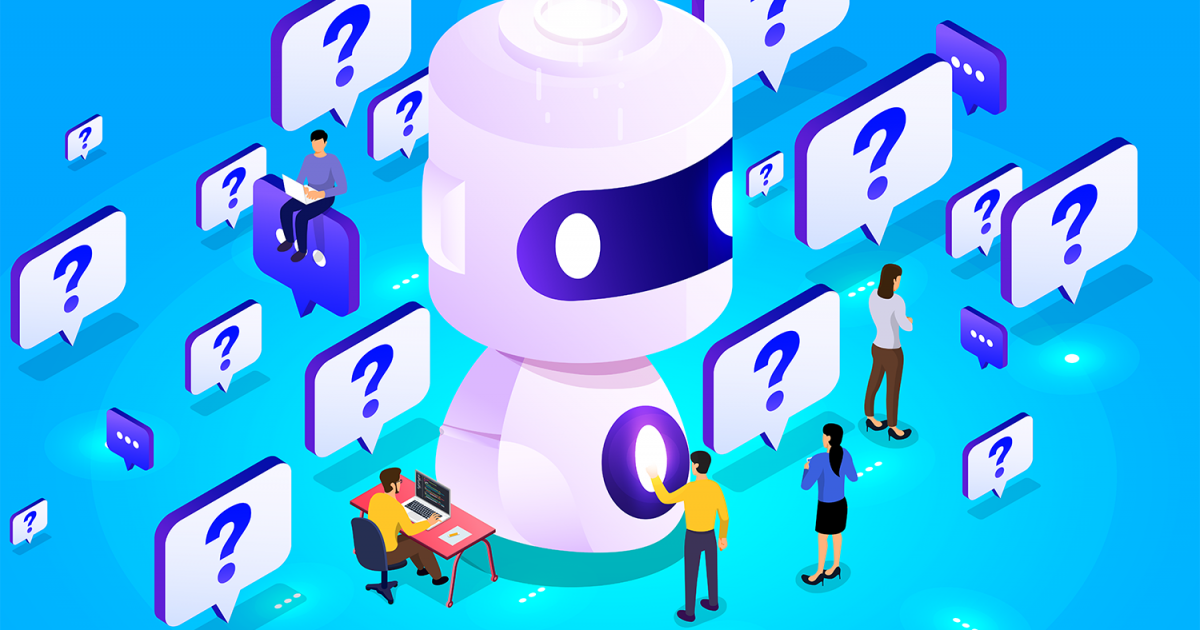
It’s 2 a.m., the week before surgery, and your patient can’t sleep. She types “Will I be awake during cataract surgery?” into a chatbot and gets an answer in seconds. Where did that answer come from?
Patients already ask AI about their eyes, and they’ll keep doing it. Your practice gets to decide what kind of AI they hear from, and whether a trained person stands behind it.
Should AI talk to your cataract patients? Maybe. Where do different AI platforms get their information? Is it reliable? How does this AI handle the emotional questions? Generic chatbot answers vary in quality by tool and topic. A well-trained AI system paired with a human that can address the emotional side of surgery gives patients help at any hour and keeps the human conversation.
Why are surgeons uneasy about AI answering patient questions?
If you’ve ever spent the first ten minutes of an evaluation undoing something a patient read online, you know the feeling.
They’re anxious, the internet is open all night, and you inherit whatever they found.
The research backs up that unease. A study published this fall in Frontiers in Ophthalmology gave 20 common cataract questions to five large language models, including GPT-5, and scored the answers for quality and educational suitability. The best model averaged 4.15 on a 5-point quality scale. Two others scored 2.15, under the 3-point line the authors used to flag lower-quality answers.
Their conclusion: these tools have potential, “but the output quality varies depending on the model and the topic.” The authors also noted they didn’t check answers against clinical guidelines, so even a high score doesn’t prove an answer is clinically right.
Other studies point the same way. A 2026 iScience comparison of four AI models found inaccurate answers to cataract questions and case scenarios in roughly 2% to 13% of responses, depending on the model, and concluded that “human oversight is still required.” Mistakes can happen, but how many is your practice willing to tolerate?
An October Frontiers in Public Health study of six chatbots tested a different eye condition, diabetic retinopathy, and found every chatbot wrote above the recommended sixth-grade reading level for patient material.
All three studies land in the same place: training and human oversight decide whether AI helps or hurts your patients.
What makes a well-trained AI different from a generic chatbot?
A general chatbot learned from the whole internet. It has never been on the phone with a 72-year-old worried about the cost of a toric lens, or one who quietly believes “cataract removal” means removing the eye. Navigate built Navi for those patients. Navi is an AI-driven Virtual Education Assistant inside navigateOS. She learned from thousands of cataract patient education conversations handled by Navigate’s Patient Navigators, so she knows the questions patients really ask, the words they use, and where they tend to get stuck.
Navi also works under clear rules. She says who she is, every time. She tells patients the line is recorded. When a patient asks for a real person, at any point in a conversation, she hands off to a trained human Patient Navigator. For Navigate, the people matter as much as the model. AI coaches every human Navigator during the call, and every call is reviewed for quality. That’s the human oversight the iScience authors said is still required, and it’s what a generic digital tool can’t give a nervous patient at 2 a.m.
How should your practice evaluate AI for cataract patient education?
1. Train: What did it learn from?
Ask what data the AI was trained or tuned on. “The internet” isn’t an answer. Look for real cataract patient conversations, your practice’s talking points, and the lens options you actually offer. The Frontiers authors found that answers on surgery and preoperative care were harder to read than other topics. Ask how a tool performs on exactly those questions.
2. Disclose: Does it tell patients what it is?
Patients deserve to know when they’re talking to AI. A tool that identifies itself, explains that the conversation is recorded, and never pretends to be a nurse protects the trust patients place in your practice.
3. Hand off: How fast can a patient reach a person?
Ask what happens when a patient says, “I want to talk to someone.” The answer should be a trained human educator who knows cataract surgery. A voicemail box or a three-day callback doesn’t count.
4. Measure: Can you see what it said?
You should be able to review conversations, see the questions patients asked, and know what reached the chart before the visit. Ask for a sample conversation before you commit.
What’s the risk of letting generic AI fill the gap?
Patients will keep asking someone. If your practice doesn’t offer a trained option, they’ll use whatever free chatbot is open on their phone. Some answers will be fine. Others will be hard to read, incomplete, or wrong, and you won’t know which until the patient is in your chair.
Memory makes it worse. Many patients don’t retain new or complex information immediately, so a confusing answer at midnight rarely gets corrected by morning. It shows up later as a longer evaluation, a patient who picks a standard lens out of uncertainty, or an empty OR slot.
What does it look like when trained AI and human educators work together?
Your patient still can’t sleep at 2 a.m. This time she reaches an assistant that knows cataract surgery, tells her plainly that it’s AI, and answers in words she understands. The next day, a Patient Navigator follows up on the cost question she wasn’t ready to ask a machine. By the time she meets you, her visual goals and worries are already in the chart. You spend the visit on clinical decisions and the lens that fits her life. Experience, patience, and emotional understanding make the difference.
That preparation pays off. 74% of Navigate-educated patients book surgery, and ATIOL adoption runs 30.5% higher than with practice education alone. You can see more of that in Navigate’s results.
Talk with us about trained AI and human educators
Your patients will use AI either way. If you’d like to see how a trained assistant and human Patient Navigators could work together in your practice, we’d be glad to talk it through.