
Most cataract practices track case volume, OR utilization, and billing cycle time. Those numbers matter, but they don’t tell you what happens between a scheduled consultation and a scheduled surgery. That gap has a name: surgical capture rate. And it may be the single most important number in your practice that nobody is watching closely enough.
What Is Surgical Capture Rate?
Surgical capture rate is the percentage of cataract consultations that convert into scheduled surgery. It’s also called consult-to-surgery conversion.
The formula is simple:
Surgical Capture Rate = (Number of Patients Who Schedule Surgery ÷ Total Consultations) x 100
If your practice sees 100 cataract consultations in a month and 75 of those patients schedule surgery, your surgical capture rate is 75%. Every point below that ceiling represents a patient who was medically appropriate for surgery but walked out the door without booking it.
Why Surgical Capture Rate Matters More Than Volume Alone
A full consultation schedule feels like a sign of a healthy practice. But volume without conversion is just activity. If your practice books more consultations this quarter and your capture rate holds steady or drops, you haven’t grown. You’ve just spent more staff time and exam lane hours to arrive at the same number of surgeries.
Cataract extraction remains one of the most frequently performed outpatient procedures in the United States, accounting for a substantial share of all major ambulatory surgeries and representing the most common procedure among patients age 65 and older, according to a statistical brief from the Healthcare Cost and Utilization Project (HCUP), a federal data partnership coordinated by the Agency for Healthcare Research and Quality (HCUP Statistical Brief). With that much consultation volume already flowing through practices nationwide, even a small improvement in capture rate compounds fast. A practice converting 200 consultations a month at 70% is leaving roughly 10 additional surgeries a month on the table for every 5-point gap to close.
For surgeons, a low capture rate often shows up as a quiet frustration: patients who seemed engaged in the exam lane, then never called back. For practice owners and administrators, it shows up as unpredictable OR scheduling, inconsistent revenue per case, and a hard number to explain to physician partners or investors.
What Drives a Low Surgical Capture Rate
Patients rarely decline surgery because they’ve decided against it. More often, they leave the consultation without enough clarity or confidence to commit on the spot.
Unanswered questions. Between the diagnosis and the consultation, most patients have questions they never get to ask. Clinic time is built for clinical decisions, not for walking a first-time patient through what cataract surgery actually involves.
Pre-surgical anxiety. A 2025 systematic review published in Nursing Open found that pre-operative patient education significantly reduces anxiety in cataract surgery patients and supports more informed decision-making. Anxious patients are far more likely to say “let me think about it” than to book on the spot.
No-shows and late cancellations. A missed consultation cannot convert to surgery. A peer-reviewed study published in BMC Health Services Research found a mean no-show rate of roughly 18.8% across primary and specialty clinics, with an average economic cost of about $196 per missed appointment. In a cataract practice, every no-show is a lost OR slot and a patient who may not reschedule at all.
How Navigate Measures Surgical Capture in the Real World
In an eight-month analysis across 11 surgeons at three ophthalmology practices, Navigate compared surgical capture rates between patients who received pre-visit education and patients who did not. Navigate-supported patients converted at a 78.6% surgical capture rate, compared to 70.5% for unsupported patients, an 8.1 point difference across every participating practice (see the full case study).
That gap holds up regardless of practice size or surgeon caseload, which is what makes surgical capture rate such a reliable KPI to benchmark against. It isn’t influenced by seasonality or marketing spend the way new patient volume can be. It reflects one thing: whether the patients already in your pipeline are prepared enough to say yes.
Surgical Capture Rate and ATIOL Adoption Are Connected, But Not the Same
It’s worth separating two numbers that often get blended together. Surgical capture rate measures whether a consultation becomes a surgery. Advanced technology IOL (ATIOL) adoption measures which lens a patient chooses once they’ve committed to surgery. Both are patient education outcomes, but they answer different questions, and both deserve their own line on your dashboard.
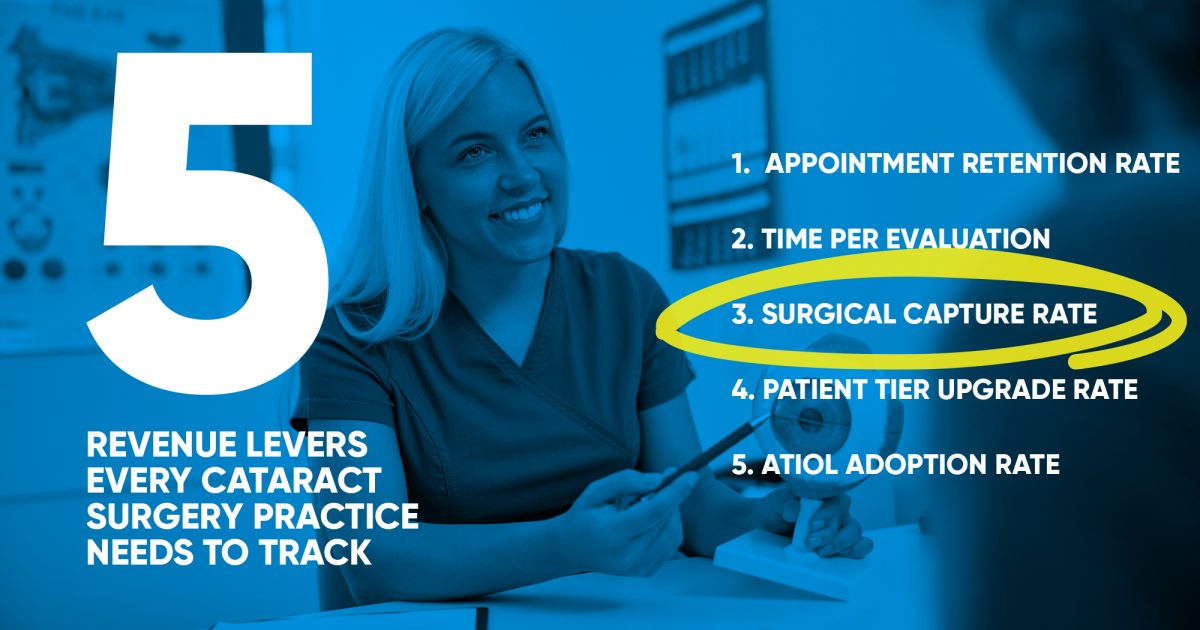
Research on IOL selection nationally shows how much room there is to grow on both fronts. A peer-reviewed study tracking premium intraocular lens utilization among cataract patients found adoption rates in the range of 9% to 11% before accounting for practice-level variation, with utilization consistently lower among Medicare-insured patients than privately insured patients. Surgical capture rate and ATIOL adoption are two of the five specific revenue levers every cataract program should be tracking, alongside appointment retention, time saved per evaluation, and tier upgrade rate.
We break down all five revenue opportunities here.
How to Improve Surgical Capture Rate in Your Practice
The most direct path to a higher surgical capture rate is closing the education gap before the consultation, not during it. When patients arrive already understanding what cataract surgery involves, what their lens options are, and what to expect financially, the consultation becomes a conversation about their specific eyes and their specific life rather than a first introduction to unfamiliar concepts.
Practices working with Navigate’s trained Patient Navigators see evaluation-to-surgery conversion rates run 15% higher, because patients arrive with their questions already answered. That preparation happens through a real human conversation, by phone, video, or text, before the patient ever sits down with the surgeon. It doesn’t replace the doctor-patient relationship. It gives that relationship a stronger starting point.
The Bottom Line
Surgical capture rate tells you something case volume and OR utilization never will: whether the patients already scheduled with your practice are prepared to move forward. It’s measurable, it’s benchmarkable, and unlike acquiring new patients, improving it doesn’t require spending another marketing dollar. The opportunity is already sitting in your consultation calendar. The question is whether your practice has a process to capture it. Navigate can help.